The Path to Taikan-ten
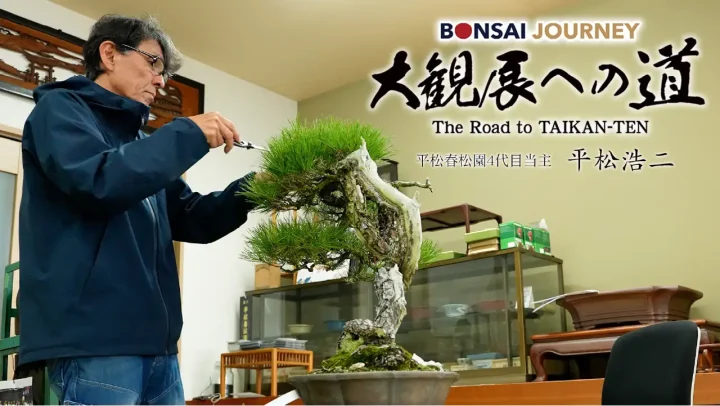
Taikan-ten, held at Miyako Messe in Kyoto. For Koji Hiramatsu, this is the place where he presents each year’s work to the world.
Yet the true beginning of an exhibition is not the venue itself. From applying moss a week beforehand, to loading the truck late at night, to setting up the next morning — the outcome is decided entirely on the path that leads there.
The Aesthetic of a «Tree You Can Drink Tea With»
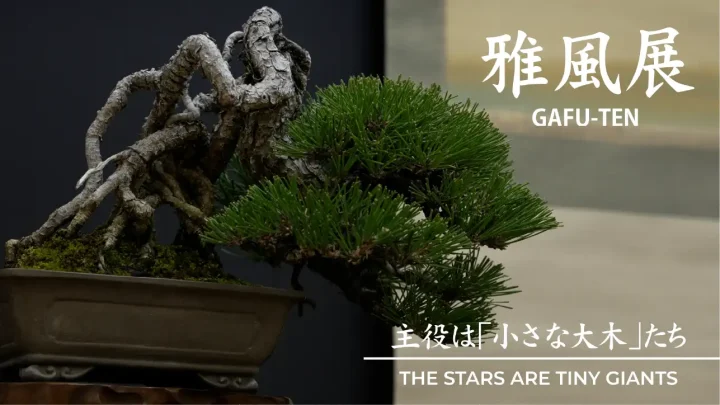
The centerpiece this time is a Japanese Red Pine in Literati Style, housed in a Shiro Kochi pot — a work developed over several years.
«It is unlike a tree of overwhelming presence» — that is what Literati Style is. People of old, it is said, would look at trees like this and remark, «This is a tree you can drink tea with.» Sensei himself says he has not yet reached that level, yet there is something in this tree that must be «appreciated through refinement.» Standing quietly, drawing you to linger beside it — Literati Style holds a beauty of that dimension.
Do not over-refine the branches. Leave the flourishes slightly loose, preserving a natural presence. The movement of natural Shari cannot be made by human hands — and so the judgment not to over-work becomes the very core of the aesthetic. Where does «doing too much» begin? Learning that boundary is perhaps something cultivated over a long, long time.
Applying Moss — That One Week
One week before the exhibition. Koji Hiramatsu takes the moss in hand. Not the day before, not the day of — it must be one week prior. The time it takes to settle after application is what determines the beauty of the finished result.
Pressing with the pads of his fingers, he spreads the moss across the surface of the pot. Not mounding it up in fluffy clumps, but naturally, as if laying down roots in the soil. Seams are pressed in with the finger pads, blended until no joint remains visible. These quiet moments of handwork will eventually determine the presence of a single tree on the exhibition floor.
Victory Lies in the Accumulation of Preparation
«The outcome is decided in the preparation. If they don’t sell, it means my own eye for quality was poor» — loading around fifty trees into a car and driving through the night, then assembling the display shelves at Miyako Messe the next morning. Sensei’s resolve is already unshakeable.
Behind the spectacle of the brilliant display lies this transportation, a week of applying moss, and years of development. By the day of the exhibition, it is already too late to change anything. All the answers already exist within the accumulated time.
An exhibition is also a place where one presents finished work to the world. What is being tested is not the conduct on the day itself, but the accumulation that preceded it — and therein lies the artisan’s pride.
As a Journey Without End
«Bonsai never ends until the day you die» — this journey has no conclusion.
Next year, moss will be applied again, the night roads will be driven again, and the path to Miyako Messe will be taken once more. It may appear to be the same repetition, yet the trees are different, the seasons are different, and one’s own eye shifts little by little. It is not work aimed at completion, but work of enjoying a journey with no completion — that may be the true nature of bonsai.